Violence and Aggression
Introduction
This document should be read alongside the NHS England Primary Medical Care Policy and Guidance Manual chapters 3, 6 and 7 (NHS England » Primary Medical Care Policy and Guidance Manual (PGM).? All NHS organisations have a legal duty to prevent violence in their workspaces and can do so by identifying and preventing the escalation of distressed behaviour and promptly responding to abusive behaviour.
Flowchart
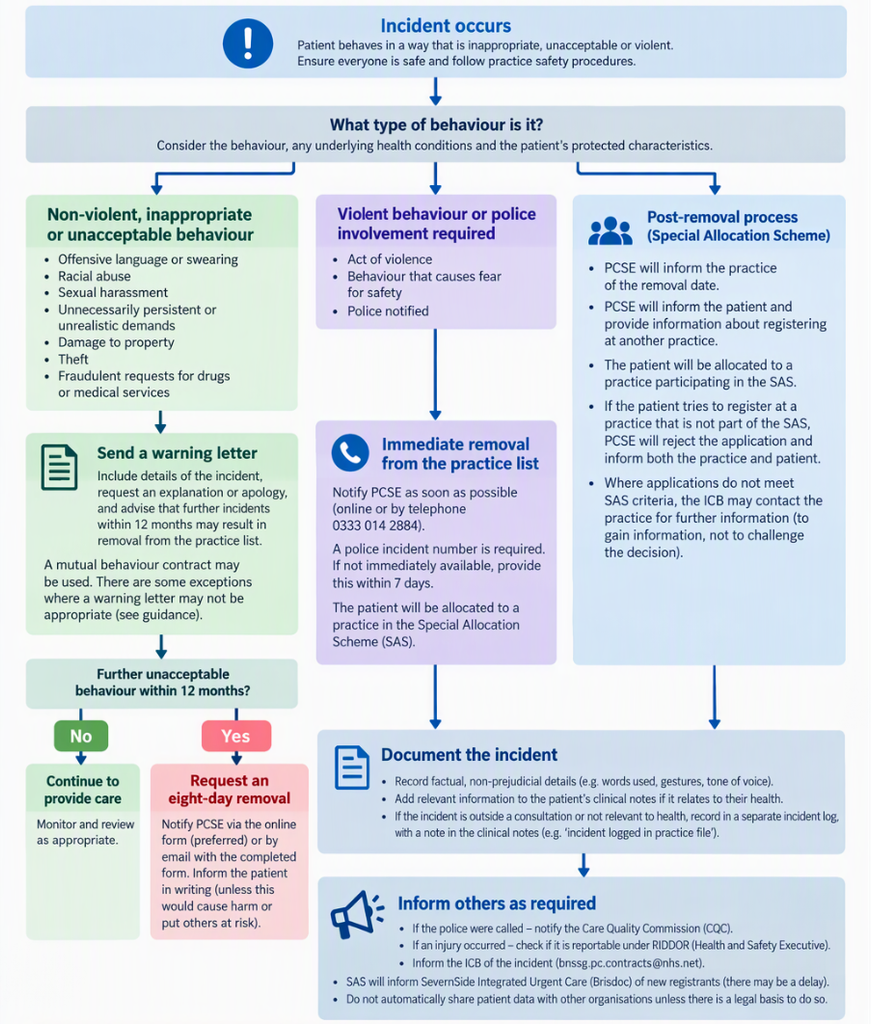
Managing non-violent, inappropriate and unacceptable patient behaviour
The PGM has defined inappropriate and unacceptable behaviours by patients to include:
- Using offensive language or swearing at practice staff or other service users
- Racial abuse
- Sexual harassment
- Unnecessarily persistent or unrealistic service demands that cause disruption
- Causing damage to practice premises, or to the property of staff or other service users
- Stealing from practice premises, staff or other service users
- Obtaining drugs and/or medical services fraudulently
If a patient has demonstrated an unacceptable behaviour which was not appropriate to report to the police, a warning letter should usually be sent. The letter should include details of the incident, request explanation or apology and inform the patient that if a further incident occurs within 12 months, they may be removed from the practice list and will need to register at another practice.? Practices may choose to use a mutual behaviour contract.
There are a few exceptions where a practice may feel it is inappropriate to send a warning letter, when such warning letter:
- would be harmful to the person’s physical or mental health
- would put at risk the safety of one or more relevant person(s)
- is not otherwise reasonable or practical for a warning to be given.
Practices must recognise and consider that incidents of patient’s behaviours may have been influenced by health conditions e.g. mental health, neurodivergence, clinical presentation. Practices must also ensure that the patient’s own protected characteristics have no bearing on the consideration process.
NHSE has a patient warning letter and mutual behaviour guidance agreement template that practices may wish to issue:
Eight-day removal from the practice list
If a practice needs to remove a patient from the practice list, Primary Care Support England (PCSE) should be notified.?
If the removal is resulting from a breakdown in the practice/patient relationship and a warning letter has been issued in the previous 12 months (advising the patient that they may be removed if they behave unacceptably), the practice can request an eight-day removal online here:
Patient Removals | PCSE (england.nhs.uk)
Online requests are preferred by PCSE, but a paper version of the completed form can also be downloaded here: 8 day removals | PCSE and emailed to?pcse.patientremovals@nhs.net?
Once the request has been accepted, PCSE will inform the practice of the date the removal will take place.
PCSE will also inform the patient that they will be removed from the practice list and when this will happen. PCSE will provide the patient with information about registering at another practice.
The practice is also required to notify the patient in writing that a request for removal has been made, unless to do so would harm the patient’s physical or mental health or put others on the practice premises at risk.
Violent patients and the special allocation scheme (SAS)
If a patient has committed an act of violence or behaves in a way that means the police must be notified, practices can remove the patient from the practice list immediately. Further information about this can be found in the ‘immediate removal’ section below.
Once the patient has been removed from the list, they will be allocated to a practice that is participating in the special allocation scheme (SAS). The patient will not be able to register with a practice that is not part of the?scheme.
If a patient tries to register at a practice that is not part of the SAS, this will be rejected by PCSE who will inform the practice and patient. Further information can be found here:
Immediate Removal (SAS) | PCSE
Immediate removal from the practice list
Practices may remove a patient with immediate effect where the patient has committed an act of violence or behaved in such a way that the contractor, practice staff, other patients or those present have feared for their safety. The incident leading to the request for immediate removal must have been reported to the police.
Primary Care Support England (PCSE) should be notified. The request can be made here:
Patient Removals | PCSE (england.nhs.uk)
Immediate removals can also be requested by telephoning the PCSE customer support centre on 0333 014 2884.
To request an immediate removal, a police incident number will need to be provided to PCSE. If this is not immediately available, the number should be sent to PCSE within 7 days of the request.?
Where applications do not meet the criteria for placement with SAS, practices?may be contacted by the ICB to provide additional information regarding the incident. This is to gain further information, not to challenge the decision. To prevent unnecessary delays, the ICB aim to do this on the same working day. Once the patient has been removed from the practice list, they will be placed on the special allocation scheme (SAS).
Documentation
Documentation of the events should be recorded in the clinical notes if they are relevant to the patient’s health. Documentation must be factual and non-prejudicial e.g. description of words used, gestures, tone of voice rather than stating the patient was rude or aggressive. A formal system for placing markers on the clinical notes should be followed to reduce possible risks to NHS staff by enabling them to consider and implement measures for their protection. If incidents arise outside of a consultation or if they are not relevant to the patient’s health, these should be documented separately from the patient notes. This may be in an incident log with a note in the clinical notes stating, ‘incident logged in practice file’.
Who else needs to be notified?
If the police have been called to an incident, please see guidance on informing the CQC here:
Police involvement in an incident – notification form – Care Quality Commission (cqc.org.uk)
If an injury has occurred because of an incident, please see guidance from the Health and Safety Executive (HSE) on the types of injury that should be reported:?
Reportable incidents – RIDDOR – HSE
The ICB should also be informed of the incident here:
SAS will inform SevernSide Integrated Urgent Care (Brisdoc) of new registrants, but there may be a delay between this and the incident. Practices would not automatically share patient data with other organisations unless they believe there is a significant risk to others. In the interests of safeguarding others, practices should consider whether they need to inform any external bodies of the incident or behaviour to enable them to conduct their own risk assessment. If a practice decides they need to notify another organisation, they must share only the minimum amount of relevant information via secure communication.
Supporting your staff
Resources are available to help members of staff who have been involved in an incident. The One Care wellbeing support Teamnet page includes details of the Health Assured Employee Assistance Programme which is available to all working in General Practice in BNSSG. General practice support and resilience team, One Care
For emotional and practical support, Victim Support can be contacted on?0808 1689111?or here:?Home – Victim Support?
NHS talking therapies offer a free and confidential service available via self-referral. The service can be contacted on?0333 200 1893, or by completing an online form here:
NHS Talking Therapies – North Somerset & South Gloucestershire (vitahealthgroup.co.uk)?
After an incident, the wider practice team should be involved in a debrief. This is an opportunity to share more widely any offers of support, and to share any learning from the incident.?
Get in touch
If you have any queries or questions, please do get in touch.
- Avon LMC can be contacted by email at?info@almc.co.uk